Perception as structured interpretation: the triggering of intrinsic meaning, not information processing
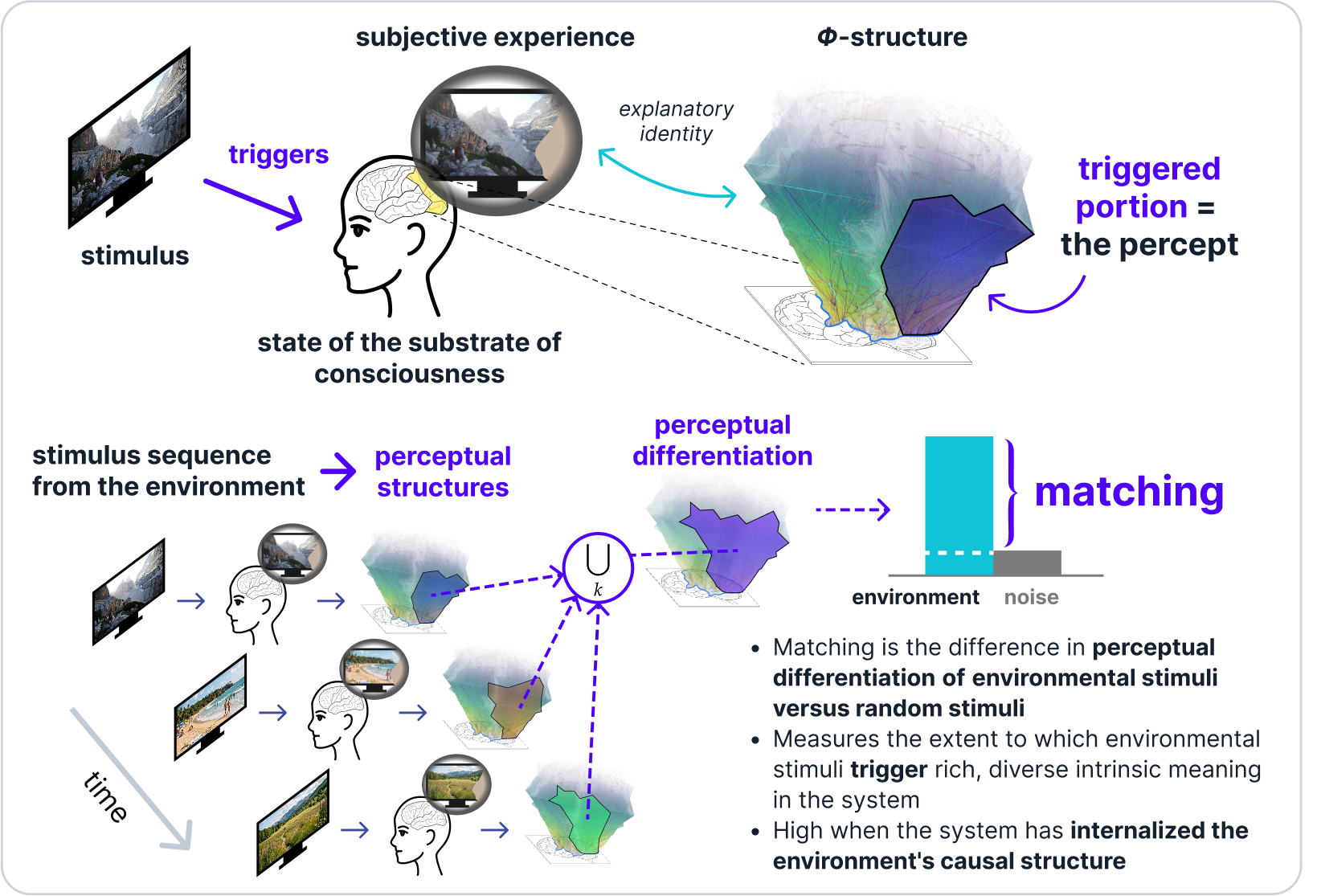
Cast a glance at the scene outside the window: in a blink of the eye, you see the forest with its intricate canopy of trees. How does this come about? A standard account is that a stimulus from the environment impinges on the retina, conveying information to the brain; the information is processed through a hierarchy of sensory areas, aided by top-down signals that try to predict, fill in, or disambiguate noisy bottom-up data; and finally, the meaning of the information is decoded, with the ultimate goal of guiding behavior. The very idea of processing suggests that the information is in the stimulus, ready to be decoded, and that meaning is in an activity pattern or “code” resulting from that processing. Somewhere along this processing chain, some of this information happens to become conscious (“conscious processing”).
IIT offers a different account: IIT starts from an experience—whether dreamt, imagined, or triggered by a stimulus—which it characterizes as a cause–effect structure, or Φ-structure. The Φ-structure is composed by distinctions and relations that define the feeling of the experience in a way that is fully intrinsic, without any reference to anything outside the complex. From the intrinsic perspective of an experiencing subject, the feeling of the experience is also its intrinsic meaning: what any content of the experience feels like—a distant sound, a sense of nausea—is also what that content means for the subject. Thus, IIT views external stimuli as triggers of intrinsic meaning, rather than as sources of information to be processed.
What, then, is the relationship between experiences and the stimuli triggering them? And how does the intrinsic meaning of experiences reflect features of the environment? Here, we extend IIT’s mathematical framework to address these questions.
Illustration of the framework with toy models of visual object perception
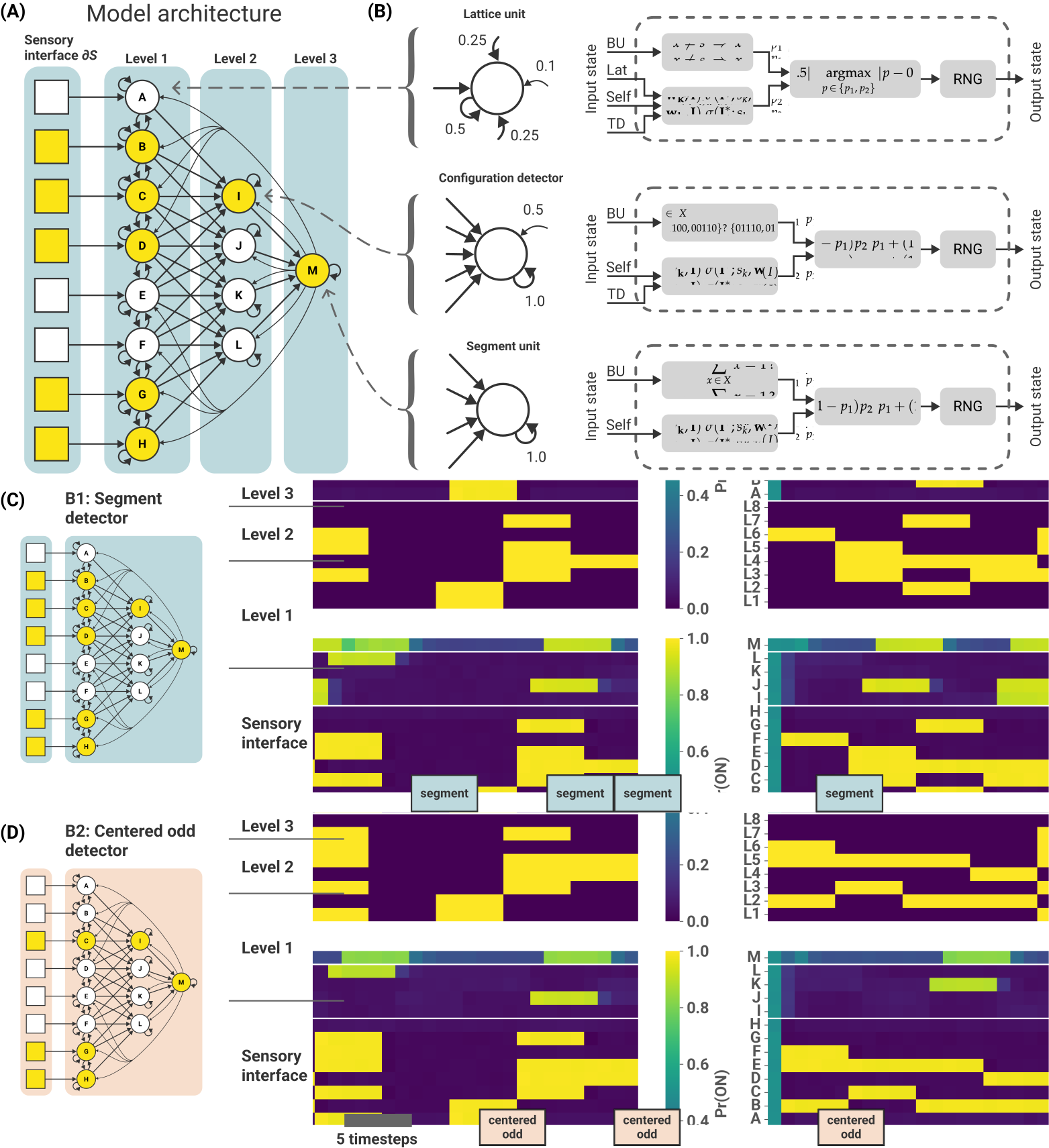
Two simple models, B1 and B2, detect different features. Left: Each is a hierarchy of stochastic units with lateral and top-down feedback: level-1 units copy the input, level-2 configuration detectors fire when their feature appears, and a level-3 invariant unit fires whenever any detector is active. Right: The dynamics of each system. B1 detects ‘segments’; B2 detects ‘centered-odd’ patterns. Note the activation of the invariant unit M in response to the tuned pattern.
The triggering coefficient measures to what extent the state of a given subset of the system was caused by a stimulus
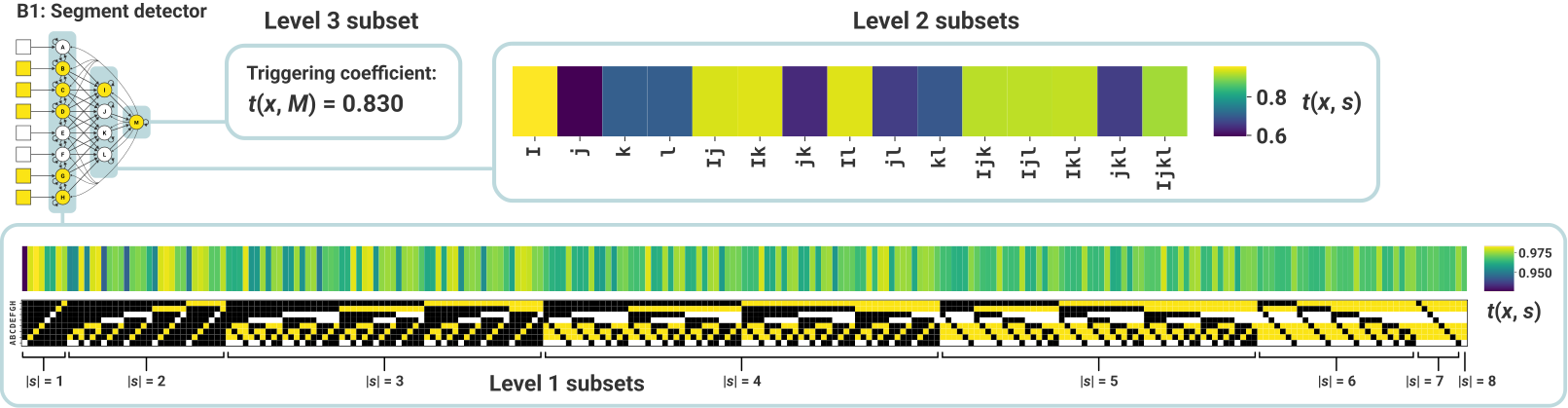
Let m be the state of a subset of the system, let x be the stimulus, and let \( p=\Pr(m\mid x) \) and \( q=\Pr(m) \). We define the triggering coefficient as:
This expresses the extent to which the stimulus x caused the subset to be in state m. It is 0 when m never occurs in response to the stimulus, and 1 when it always occurs in response. Here we show its values for the subsets of L1, L2, and L3 of B1 when the system is presented with a segment pattern. Note that the active detector unit and the invariant unit have high triggering values, reflecting their selectivity for this stimulus; this indicates the stimulus is causally responsible for their activation.
A perceptual structure is the portion of a Φ-structure triggered by a stimulus
The Φ-structure is composed of distinctions and relations. We call the subset of those components supported by a particular subset m of the system the φ-fold of m. Its perception value is the sum of the φ-values of those components, weighted by t(m), its triggering coefficient: i.e. the fraction of the φ attributable to the stimulus. The φ-folds together form the perceptual structure: the portion of the Φ-structure that was triggered by the stimulus. The sum of perception values is the perceptual richness:
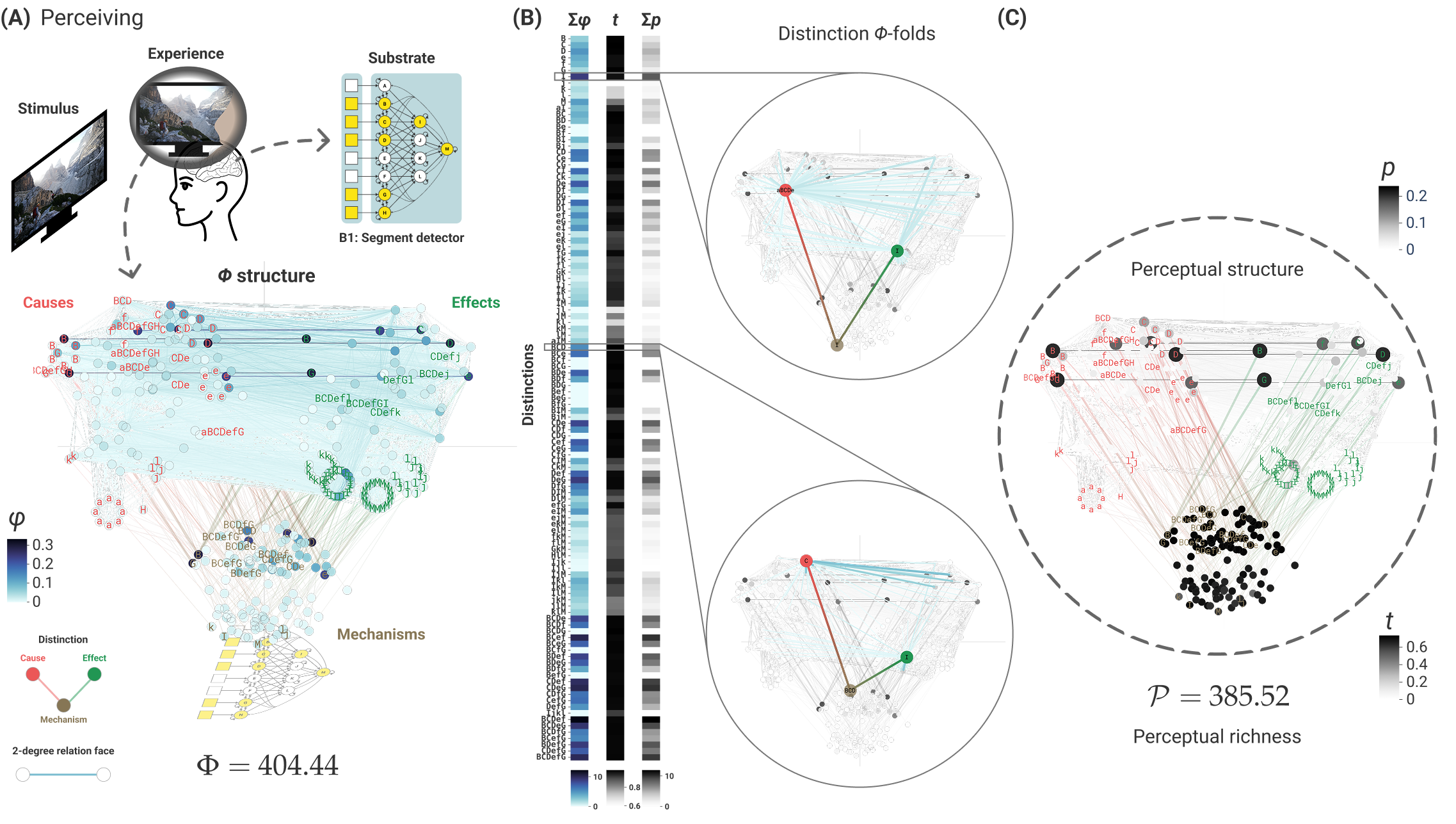
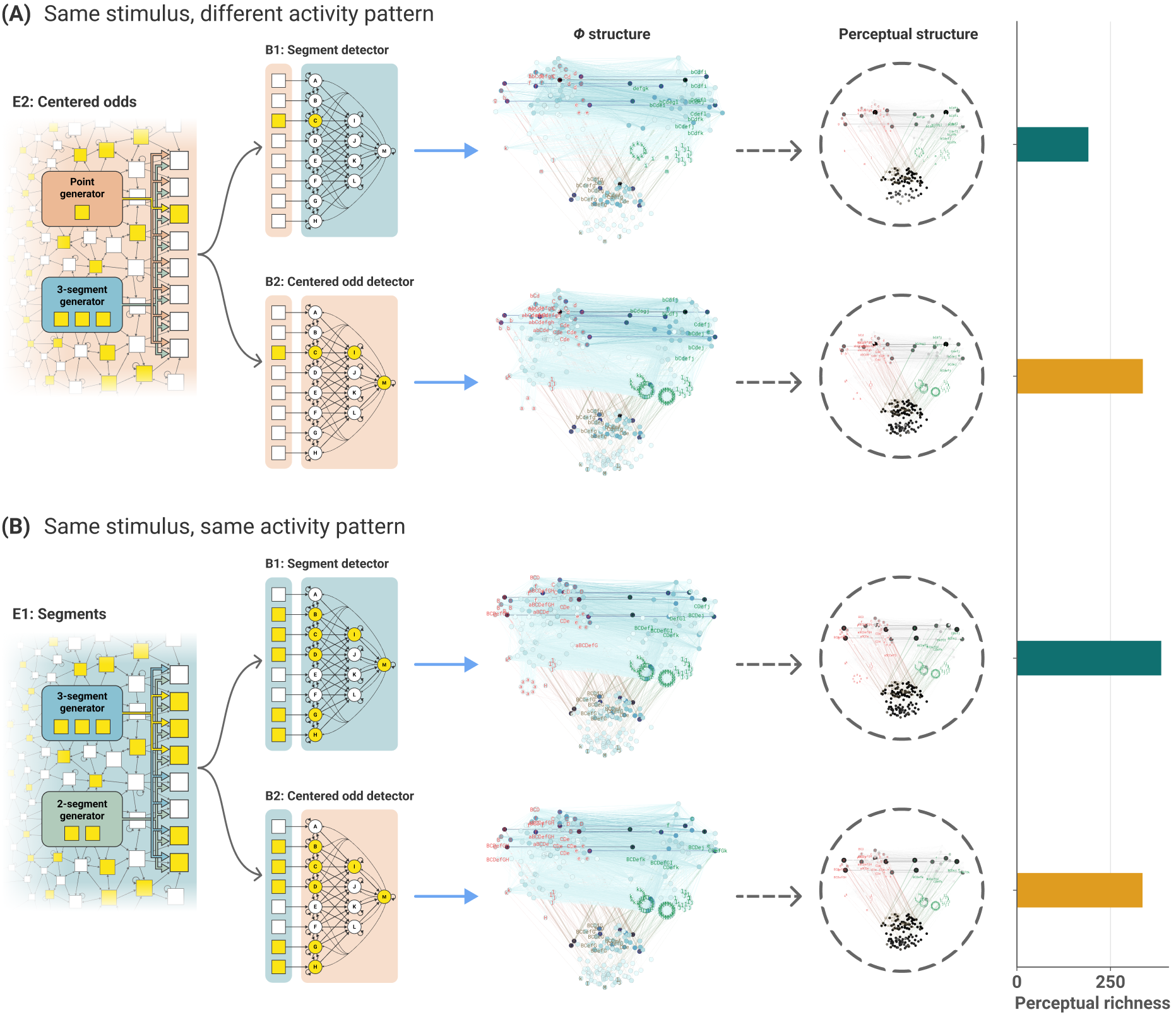
The same stimulus can trigger different perceptual structures in different systems: every perception is an interpretation
The same stimulus can elicit different response states in different systems (left). However, even when the activity pattern is exactly the same, the perceptual structure can be different (right). B1 interprets the stimulus as a segment (and not a centered odd) while B2 interprets it as a centered odd (and not a segment). It is the causal power of the system’s units that matters for perception, not activity patterns as such.
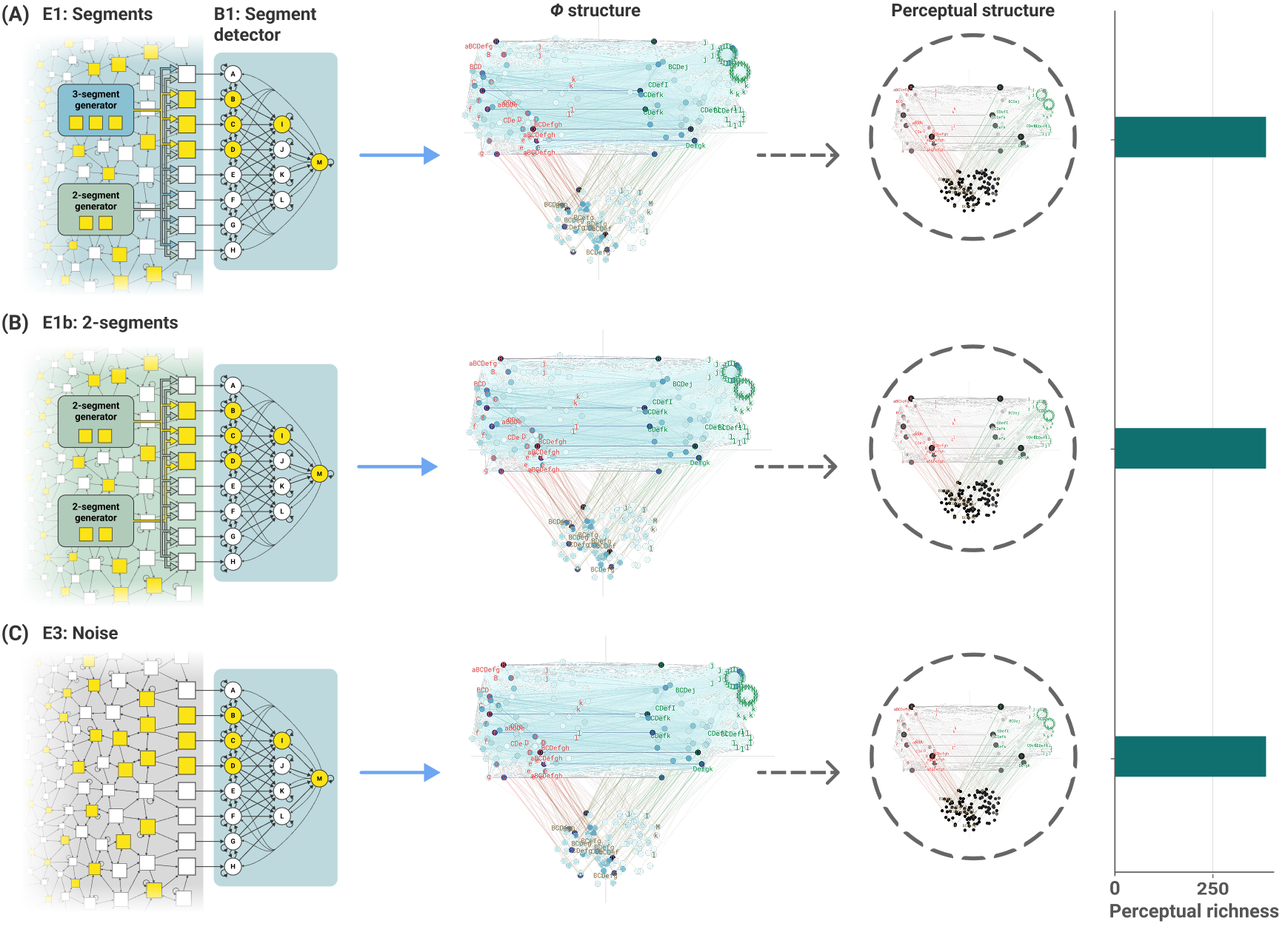
Perception is intrinsic—it need not involve reference or representation
Here, 3 different environments produce the same stimulus (a ‘segment’ state). A true 3-segment, a spurious coincidence of 2-segments that appears as a 3-segment, and a 3-segment appearing purely by chance all trigger the same response state and perceptual structure. This illustrates a simple but important point: perception and meaning, being intrinsic, do not necessarily involve reference or representation of causal features of the environment.
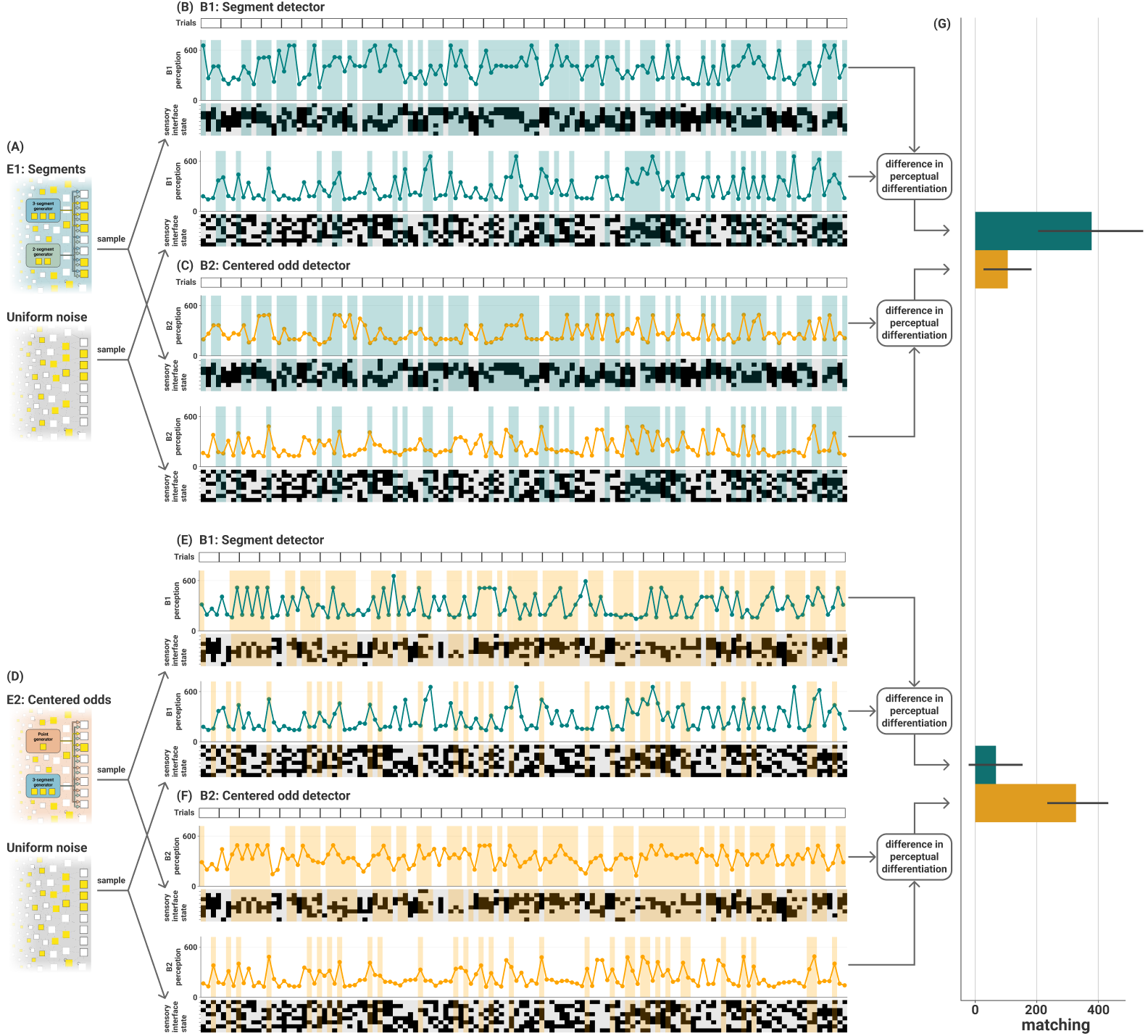
Matching measures the degree to which a system has internalized an environment’s causal regularities
Perceptual differentiation is the total perception value of the union of the perceptual structures across a stimulus sequence. It captures the richness and diversity of the perceptual structures triggered—i.e., how meaningful an environment is to the complex:
Matching is then defined as the maximum expected difference between perceptual differentiation for environmental stimuli versus random stimuli:
It is high when the environment triggers more diverse and rich intrinsic meanings than would be expected by chance. Here, B1, which detects ‘segment’ stimuli, has a higher matching value when perceiving stimuli from the ‘segment’ environment, where those stimuli occur frequently (highlighted timesteps); likewise, B2 matches better to the ‘centered-odd’ environment. Their connectivity has internalized aspects of the causal processes in their respective environments (here, by design). Well-adapted systems whose intrinsic connectivity was molded by evolution, development, and learning can be expected to allocate a large set of their intrinsic meanings to reflect causal regularities of the environment that are relevant for fitness.
Acknowledgments
We thank Larissa Albantakis and William Marshall for their contributions during the early stages of this project; Leonardo S. Barbosa, Melanie Boly, Tom Bugnon, Keiko Fujii, Andrew Haun, Armand Mensen, and Shuntaro Sasai for helpful discussions; and Larissa Albantakis, Chiara Cirelli, Francesco Ellia, Graham Findlay, Matteo Grasso, and Alireza Zaeemzadeh for valuable comments on the manuscript. B.E.J. was supported in part by the Research Council of Norway (FRIPRO grant no. 335828). G.T. acknowledges support from Templeton World Charity Foundation (nos. TWCF0216 and TWCF0526). The opinions expressed in this publication are those of the authors and do not necessarily reflect the views of Templeton World Charity Foundation.
Data and code availability
All code to reproduce the analyses and figures is available at github.com/wmayner/matching. The precomputed data are archived
on Zenodo at doi.org/10.5281/zenodo.20972063. The
substrate_modeler package used to construct the model systems is available at github.com/bjorneju/substrate_modeler.